

Support
On Marine Environment recordings
Note: All articles on this website are original. It is strictly prohibited for similar commercial websites to plagiarize them
Author: Gan Weimin
People perceive the world through seeing, hearing and touching. Therefore, listening to recordings is also one of the important ways for people to understand nature.
Recording is the process of capturing a certain sound, with the aim of allowing people to enjoy it during playback and for analysis and application in engineering and scientific research exploration. As soon as people listen to the recording, they can tell whether the song is sung by a male or female singer. They can also tell the title of the song, the name of the singer, whether it is sung in a popular or professional style, and even the main instrument used for playing. They can also mention many other things... Experienced fish listeners at sea can not only know the size of the school of fish but also the types of fish based on the recordings. Therefore, we come to such a conclusion that we can identify objects through recordings.
Audio recording has very wide applications in engineering and scientific research. Through audio recording, people can identify mechanical faults and determine the location of oil leakage in Marine pipelines. In the field of biology, people can identify birds with the help of audio recordings. In terms of public safety, the police can identify criminals with the help of audio recordings. In the military field, audio recordings can be used to collect the unique frequencies and related intelligence of enemy radars, aircraft, ships, submarines and guns, providing support for determining positions and quantities during combat... It can be seen that recording also plays an important role in the ocean.
If we want to understand the ocean, audio recording plays a very important role. Managing the ocean also requires audio recording of it.
Recording has a dual function: first, it serves as the foundation for understanding; second, it is the basis for management and monitoring.
The ocean covers more than 70% of the Earth's surface. In this vast ocean, there are many mysterious colors. It is vast and expansive, with huge underwater pressure and a complex environment. This adds great difficulty to understanding the ocean. Beneath the serene ocean lies a Marine world filled with all kinds of sound waves. The sounds produced by waves and vortices on the sea surface, the noise generated by the flow of seawater near underwater mountains or certain objects, the underwater noise produced by tsunamis, the sounds made by Marine life, underwater volcanic eruptions or earthquakes, the thermal movement of seawater molecules and the passage of ships, as well as the noise produced by Marine oil extraction and factories near the coast.
First, we continuously and over a long period of time record the sounds (noise) in a certain sea area, and then analyze the recorded sounds (waves) (spectral analysis) to identify the characteristics of various sounds. After completion, we will conduct investigations on many major sounds (waves) with the aim of identifying what objects emit or produce these sounds (waves). For instance, after we complete the analysis of sound waves, spectrograms and other characteristics of a certain recorded sound (wave), we will learn through the investigation that this sound (wave) is emitted by the eruption of that volcano at the bottom of the sea. Then we can apply this achievement widely, because when it is collected for the second time, we will know that this volcano has erupted.
The sounds of Marine life are diverse and strange, such as the sound of a propeller hitting water, the wail of an owl, the croaking of a frog, or the shrill sound of an octopus; When catfish swim at night, they make a "thump thump" sound like that of a military drum. Pufferfish and spiny dolphins make "snore", "snore" sounds. The astonishing rapid-fire sounds made by groups of small shrimps! As shown in the following figure is the spectrum diagram of the chirping sounds made by a certain type of fish
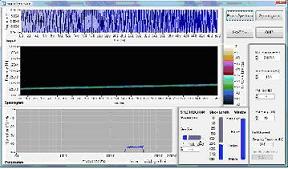
By analyzing the spectral characteristics of the recorded ocean sounds, most of the sounds in the deep sea can be distinguished. By studying the characteristics of these sounds, once we have mastered the audio features of these fish or mammals, we can distinguish them when we hear the singer's song again, just like listeners. That is to say, after collecting the sounds of blue whales, fin whales, humpback whales, ships or earthquakes again, we can know who is making the sound.
The noise generated by waves is related to the wind force and sea conditions on the sea surface. By using the noise of this frequency, the wind level and sea conditions on the sea surface can be monitored. The underwater noise generated by tsunamis can be used to predict tsunamis. The sounds made by Marine organisms are related to their species and living conditions. Listening to the characteristics of such sounds to distinguish the species of organisms can help understand their living patterns and provide information for the study of fishery resources. In addition, it is possible to control the activities of Marine life by using acoustic signals to meet human needs.
Based on the recordings, we can identify the noise characteristics emitted by various ships and distinguish the noise characteristics of different submarines.
Then, through accurate analysis of the recorded data and investigation of the attributes of these sounds, it actually provides you with a powerful recognition ability. Its subsequent uses are very extensive.
Marine recording application
Marine environment monitoring
The Marine ecosystem is an important ecosystem on our planet, and our survival cannot do without the ocean. Therefore, to protect Marine ecosystems, maintain Marine environmental security and safeguard the health of Marine ecosystems, it is necessary to enhance Marine environmental monitoring and the protection of Marine ecology, and intensify efforts to protect the Marine ecological environment. This is inseparable from the monitoring and analysis of Marine environmental noise. The following are the distribution characteristics of Marine noise sounds in the ocean as shown in the figure:
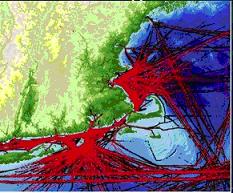
From the above picture, we can see that the closer to the coast, the louder the environmental noise of the ocean, but it is not constant. Each different location is different and changes over time. The distribution of different sound sources forms the entire noise network, including the sounds of shipping motors, wave noise, the vocalization of Marine life, other man-made sounds and natural sounds.
The first step to achieving the management and monitoring of the ocean is still audio recording. Only by analyzing the recorded data and comparing it with the previous analysis results can one quickly identify the pollution sources in the near sea and understand the impact of ship navigation and coastal industries on the ecological environment of the near sea.
Marine audio recording and spectral analysis is an important component of Marine ecological environment monitoring and a crucial tool for verifying the protection of the Marine ecological environment.
(2) Marine fish industry management
Marine recording provides a powerful means for Marine fishery management. Through long-term recording, we can understand the distribution of fish throughout the year, the types and quantities of fish, and also track fish schools.
(3) Marine scientific research
Ocean recordings can provide a powerful research tool for studying Marine life, submarine earthquakes, submarine volcanic eruptions, and Marine development.
(4) Offshore oil extraction
Monitor the operation status of various oil equipment underwater in the ocean and quickly identify the location of oil pipe leakage.
(5) Military use
Collect the sound characteristics of enemy warships and submarines to provide precise parameter support for quickly identifying their positions and quantities at long distances.